What is Provably Fair? How It Works
Provably fair explained simply — what it means, how commit–reveal works for players and operators, why it builds trust, and how VFairGames ships verifiable casino games.
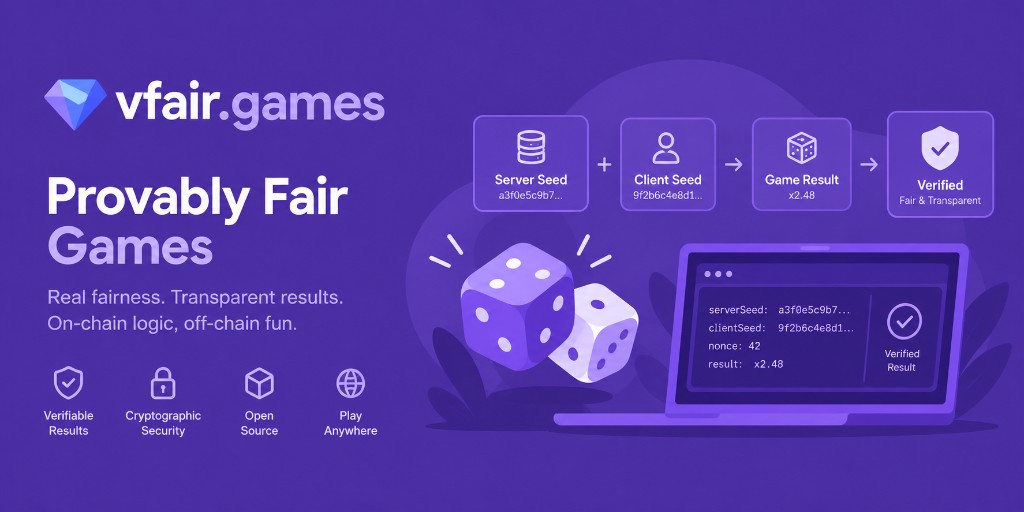
Provably fair is a way to run online casino games so anyone can check that a result was locked in before the bet and was not swapped afterward. You do not have to take the operator’s word that an RNG “was fair” — you can re-check the round from public inputs.
This guide is a plain overview for players and operators: what provably fair means, how the commit–reveal flow works at a high level, why it matters for trust, and how VFairGames uses it across Dice, Mines, Limbo, Plinko, and Keno. For game-by-game mechanics, see the Dice, Limbo, and Plinko posts.
What is provably fair?
In many traditional online casino games, outcomes come from a closed random number generator. Labs may audit the class of RNG, but a player usually cannot re-run the exact draw for their own round.
Provably fair casino games change that model:
- The house commits to secret randomness before play (typically by publishing a hash of a server seed).
- The player (or their client) adds their own input — a client seed.
- A published formula turns those inputs into the game outcome.
- Later, the house reveals the server seed so anyone can recompute and match what the UI showed.
If the revealed seed does not match the earlier hash, or if recomputing the formula does not match the shown result, the mismatch is visible. That is the core promise: detectable honesty, not “trust us.”
How it works: commit, combine, reveal
Think of it as three beats rather than a black box.
Commit
Before you play under a given seed, the operator shows a fingerprint of their secret server seed (a hash). That fingerprint is the commitment: they cannot quietly switch to a different seed later without breaking the hash you already saw.
Combine
Your client seed mixes player-controlled entropy into the round. A counter (nonce) keeps each bet unique while the same seed pair stays active. Together with the server seed, those inputs feed a public cryptographic function that produces the bytes used for that game’s outcome.
You do not need to memorize library names to understand the idea: same published inputs + same published mapping → same result. Changing any input changes the outcome.
Reveal
When the operator reveals the server seed, anyone can:
- Confirm the reveal matches the hash shown before play.
- Re-run the published formula with the client seed and nonce for that bet.
- Apply the game’s published mapping and confirm it matches the UI.
Public verification tools make those steps practical without writing your own crypto. VFairGames ships a verification tool for that check.
Why provably fair matters for trust
For players, the value is simple: every settled round can be challenged with math instead of a support ticket that ends in “our RNG said so.”
For operators and platforms, it is a product feature as much as a fairness story:
- Disputes shrink — you can point to seeds and a public recompute path.
- Differentiation — originals such as Dice, Mines, Limbo, Plinko, and Keno are expected to expose fairness UI in crypto and white-label stacks.
- Clear boundary — fairness lives in the game layer; wallets, KYC, and payouts stay with the partner.
Provably fair answers a narrow but important question: was this result produced by the published rules from the committed seeds? It does not replace responsible gaming, licensing, or payment integrity. It also does not prove that RTP tables are “generous” — only that a given draw followed the committed formula.
What players should still watch for
Honest overviews set limits:
- RTP and house edge are product settings, not proven by a seed reveal alone.
- Payouts and balances depend on the operator’s wallet and ops — fairness of the draw is not the same as “you will always get paid.”
- Client seed hygiene matters: rotating or setting your own client seed strengthens the shared-entropy story versus leaving a default forever.
- Published mapping rules matter: a reproducible formula still needs clear docs so verification is possible.
How VFairGames uses provably fair
VFairGames (VFair) is an open-source B2B platform for provably fair casino games aimed at operators: Dice, Mines, Limbo, Plinko, and Keno with configurable RTP and in-game fairness details.
Partners keep wallets and payments on their side while embedding games that already ship with verifiable randomness. Browse the games catalogue, see services for integration and custom builds, or email info@vfair.games to talk through your stack.
FAQ
What does provably fair mean in simple terms?
It means the house commits to randomness before the bet, combines it with player input through a public formula, and later reveals enough for anyone to re-check that the shown result matches.
How do you verify a provably fair result?
Save the server seed hash before play. After reveal, confirm the hash matches, recompute the published formula with your client seed and nonce, then apply the game’s mapping and compare to the UI — or use a public verification tool.
Are all online casino games provably fair?
No. Many studio slots and live tables rely on certified RNG without per-round player verification. Provably fair is most common on operator “originals” such as Dice, Mines, Limbo, Plinko, Keno, and Crash-style games.
Does provably fair mean I cannot lose?
No. It means you can check that the draw followed the committed rules. House edge, bet size, and game choice still decide expected return.