How Plinko Works — Risk Levels, Rows, and Edge Multipliers
Learn how Plinko works — Easy to Expert risk, 8–16 rows, centre vs edge buckets up to 10,000×, and HMAC-SHA256 path verification.
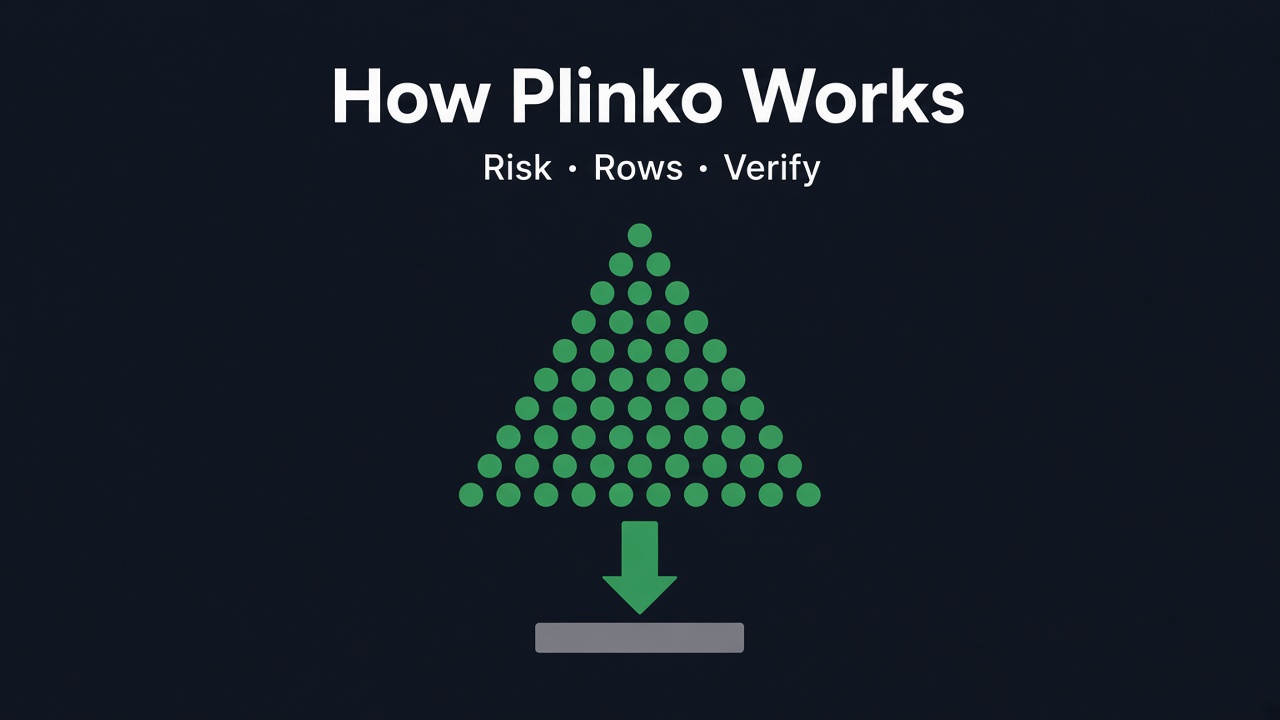
How Plinko works is a peg-board drop: you set bet, risk, and rows, a ball bounces left and right through the pins, and you get paid the bucket multiplier × stake where it lands. Centre buckets pay less; edge buckets hold the big wins — up to 10,000× on Expert with 16 rows.
This guide covers the play loop on VFair Plinko, how Easy→Expert and row count change the board, why centre and edge payouts differ, and how HMAC-SHA256 path verification lets anyone re-check a drop.
How Plinko play works
On VFair Plinko, each drop needs three inputs:
- Set the bet amount.
- Choose risk — Easy, Medium, Hard, or Expert (default Medium).
- Choose rows — 8 to 16 pin levels (default 12).
- Drop a ball — it lands in one of the buckets under the board.
Payout rules match the product:
- There are rows + 1 buckets (for 16 rows, buckets
0through16). - Your payout is stake × that bucket’s multiplier.
- Multipliers below 1× (common in the centre on high risk) return only part of the stake — a net loss, not a full wipe in every case.
Auto can run drops in a loop (including an infinite count). Instant Bet speeds up the ball animation and auto pacing; it does not change multipliers or fairness.
Browse the full games catalogue for Dice, Mines, Limbo, Plinko, and Keno.
Risk levels and rows (Easy → Expert, 8–16)
Two settings shape the board. They do different jobs:
| Control | What it changes | What it does not change |
|---|---|---|
| Risk (Easy / Medium / Hard / Expert) | The multiplier table — how aggressive edge vs centre payouts are | The chance of each bucket (still fair 50/50 pin bounces) |
| Rows (8–16) | How many pin levels the ball crosses, and how wide the multiplier spread is | The fairness model — every row still uses the same HMAC path rules |
Higher risk pushes more value into the outer buckets and can drop centre multipliers very low (Expert includes 0.1× centres on tall boards). More rows add more buckets and usually a wider top-to-bottom spread.
Edge highs climb with risk and rows. On Expert, for example, the top edge rises from tens of × on short boards toward 10,000× at 16 rows. Hard at 16 rows tops out at 1,000× — so “10,000×” is specifically Expert + 16 rows, not every high-risk setup.
Centre vs edge buckets (up to 10,000×)
Each pin is a fair left / right split. Landing in bucket k means the ball went right exactly k times out of rows drops — a binomial chance. Most paths land near the centre, so those buckets pay less. Edge buckets (all left or all right) are rare, so they hold the top multipliers.
On Expert with 16 rows, the published table puts 10,000× on both edges and 0.1× across the centre slots. That is the volatility story operators care about: frequent small centre results, rare edge hits.
Plinko on VFair uses fixed paytables (theoretical expected return sits near ~99% depending on rows and risk). Unlike Dice, Mines, or Limbo, partner RTP is not a slider that rebuilds Plinko odds — risk and rows pick a published table.
How to verify a Plinko path
Like the rest of the VFair catalogue, Plinko uses HMAC-SHA256 commit–reveal — but the digest maps to a path, not a single number:
- Before play under a seed, players see a server seed hash (a commitment).
- For each pin row,
HMAC-SHA256over the server seed with messageclientSeed:nonce:cursorproduces a float. - Float ≥ 0.5 → right; otherwise left. The count of rights is the bucket index.
- After reveal, anyone can recompute the left/right sequence, match the bucket, then look up that bucket on the published multiplier table for the round’s risk and rows.
Independent re-check: verify.vfair.games. Deep dive on the general model: What is provably fair gaming?.
What verification proves: this path and bucket came from the committed seeds. What it does not prove: wallet payouts, deposit safety, or that a given risk level is “best” for players.
The on-screen bounce is steered to the already settled bucket for clarity. Fairness checks recompute the HMAC path, not the physics animation.
Why operators ship Plinko
For online casinos, crypto casinos, white-label platforms, and agencies, Plinko is a strong originals pick because:
- Players already know the peg-board drop from TV and casual games.
- Risk × rows gives a clear volatility dial without a complex ruleset.
- Edge chase (including 10,000× on Expert 16) sells the highlight reel; centre buckets keep most rounds small and fast.
- Fairness UI and a public verifier turn “was that drop fair?” into “here are the seeds; recompute the path.”
Try it and verify a drop
- Open Plinko and place a bet (demo-friendly for evaluation).
- Note fairness inputs for the round (server seed hash, client seed, nonce) plus rows and risk.
- After seed reveal, re-check the path and bucket in verify.vfair.games or the in-game fairness flow.
Evaluating VFair for your casino or platform? Email info@vfair.games.
FAQ
How does Plinko work in one sentence?
You set risk and rows, a ball’s left/right path is drawn from HMAC-SHA256 seeds, and you get paid stake × the multiplier of the bucket it lands in.
What do Easy, Medium, Hard, and Expert change?
Only the paytable. Bucket chances stay binomial from fair pin splits. Higher risk raises edge multipliers and can cut centre payouts (including 0.1× on Expert).
When can you hit 10,000×?
On VFair’s published tables, 10,000× is the edge multiplier for Expert risk with 16 rows. Other risk/row pairs top out lower (for example Hard at 16 rows maxes at 1,000×).
Why do centre buckets pay less than the edges?
Most paths land near the centre, so those buckets pay lower multipliers. Edge buckets are rarer and hold the top payouts.
How do I verify a Plinko drop on VFair?
Confirm the revealed server seed hashes to the pre-play commitment, recompute each row’s HMAC to rebuild the left/right path and bucket, then compare to bet history — in-game or at verify.vfair.games. Map the bucket to the published table for that risk and row count to check the multiplier.