How Provably Fair Dice Works — Roll Under, Win Chance, and Verification
Learn how provably fair dice works — roll under or over, linked win chance and multiplier, and HMAC-SHA256 verification players and operators can re-check.
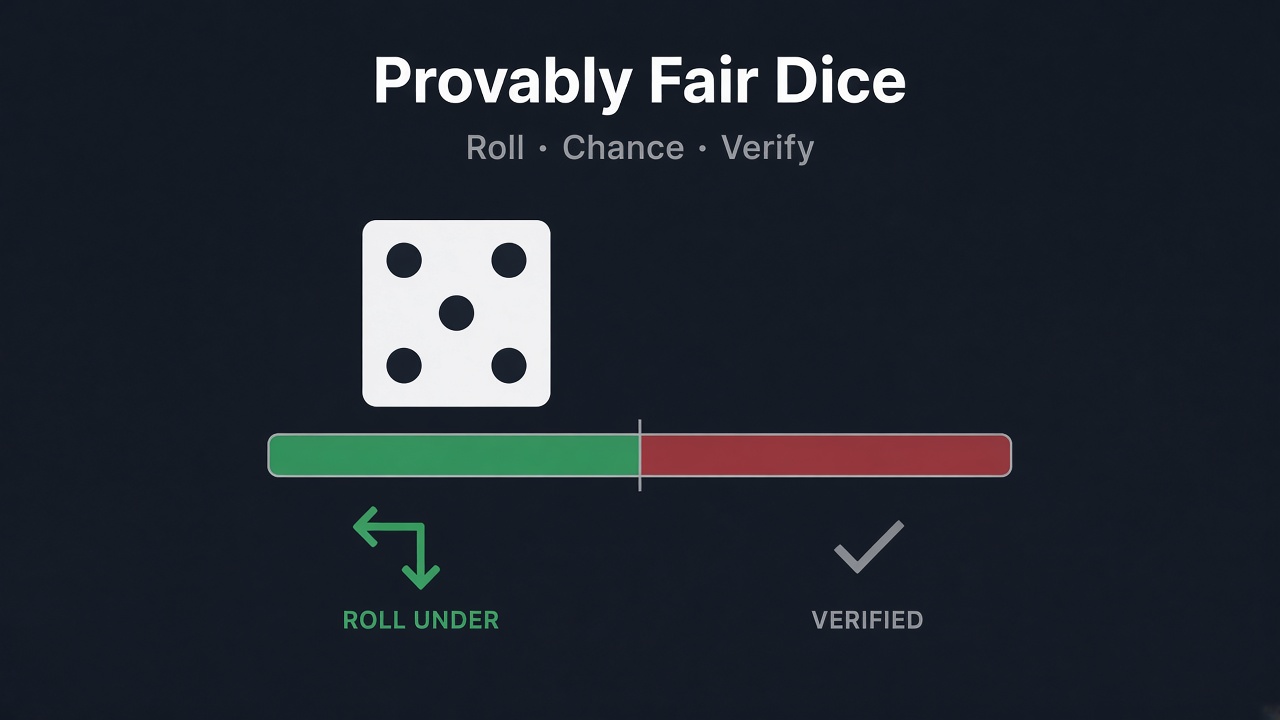
Provably fair dice is a casino originals game where you set a target on a 0–100 roll, choose Roll Under or Roll Over, and can re-check the result from published seeds — not from a closed RNG box.
This guide covers the mechanic, how win chance and multiplier stay linked, how HMAC-SHA256 commit–reveal locks the roll, and how operators use that story on VFair Dice.
How Dice play works
On VFair Dice, each round is one number in the 0–100 range:
- Set the bet amount.
- Set win chance (or the target slider / multiplier — they stay linked).
- Choose Roll Under or Roll Over.
- Place the bet — the roll resolves instantly against your target.
Mode rules match the product page:
- Roll Under — you win if the result is below your target.
- Roll Over — you win if the result is above your target.
Switching modes flips which side of the range pays. Win chance and payout stay tied either way. Lower win chance → higher multiplier; higher win chance → more frequent, smaller wins.
Auto can run a streak of rolls. Optional stop-on-profit and stop-on-loss end the session early when cumulative profit or loss hits the limit you set.
Browse the full games catalogue for Dice, Mines, Limbo, Plinko, and Keno.
Win chance and multiplier (same edge at every target)
Public Dice explainers and review sites keep hitting the same math point: the house edge lives in the payout formula, not in a “lucky” target.
On VFair, multiplier and win chance move together from the configured RTP:
multiplier ≈ (RTP × 100) / win chance %
Default RTP in VFair game math is 98% (partners can configure RTP within product bounds). At that default, a few example pairs:
| Win chance | Approx. multiplier (98% RTP) |
|---|---|
| 5% | 19.60× |
| 10% | 9.80× |
| 25% | 3.92× |
| 50% | 1.96× |
| 75% | 1.3067× |
| 90% | 1.0889× |
So a 50% win-chance bet does not “beat” a 10% bet over the long run when multipliers are RTP-scaled — it only changes how often you win and how large each hit is. That is the product story operators need when players ask for the “best” slider setting.
How provably fair dice verification works
Like the rest of the VFair catalogue, Dice uses HMAC-SHA256 commit–reveal:
- Before play under a seed, players see a server seed hash (a commitment).
- A client seed (player-side) and a per-bet nonce feed the HMAC message.
HMAC-SHA256produces a digest that maps to the 0–100 roll shown in the UI.- After reveal, anyone can check that the revealed server seed matches the earlier hash, recompute the HMAC, map it again, and match the stored roll.
Deep dive on the general model: What is provably fair gaming?. Independent re-check for settled rounds: verify.vfair.games.
What verification proves: this roll came from the committed seeds and the published mapping. What it does not prove: that RTP is generous, that the wallet will pay, or that deposits are safe. Those sit outside the hash — same honesty bar as any good PF write-up.
Why operators ship provably fair Dice first
For online casinos, crypto casinos, white-label platforms, and agencies, Dice is often the first “originals” title because:
- Players already understand under / over and a win-chance slider.
- Every target stays on the same long-run RTP story when multipliers are formula-driven.
- Fairness UI and a public verifier turn support disputes into “here are the seeds; recompute.”
- Partners keep wallet, KYC, and payments on their side while embedding a game that already ships with verifiable randomness.
VFair Dice adds partner-ready controls around that core: configurable RTP, demo play before wallet go-live, and Auto limits players can set themselves.
Try it and verify a roll
- Open Dice and place a bet (demo-friendly for evaluation).
- Note fairness inputs shown for the round (server seed hash, client seed, nonce).
- After seed reveal, re-check the outcome in verify.vfair.games or the in-game fairness flow.
Evaluating VFair for your casino or platform? Email info@vfair.games.
FAQ
What is provably fair dice?
It is Dice played with commit–reveal randomness: the operator commits to a server seed hash before bets under that seed, the roll comes from HMAC-SHA256 with your client seed and nonce, and anyone can recompute the result after reveal.
Does Roll Under pay better than Roll Over?
No. Modes flip which side of the range wins. At the same win chance, the linked multiplier (and long-run RTP) stays aligned — you are not getting a hidden edge by preferring one mode.
How do I verify a Dice roll on VFair?
Confirm the revealed server seed hashes to the pre-play commitment, recompute HMAC-SHA256 with the client seed and nonce, map the digest to the roll, and compare it to the bet history — in-game or at verify.vfair.games.
Can partners change Dice RTP?
Yes. VFair supports configurable RTP within product bounds; default game math uses 98%. Multipliers recalculate from the configured RTP and win chance so every slider position stays on the same edge model.