Casino Pattern Myths — Hot Tiles, Due Numbers, and Provably Fair
Learn why casino pattern myths fail on VFairGames — hot tiles, due numbers, and corners cannot beat seed-derived Mines, Keno, or Dice outcomes.
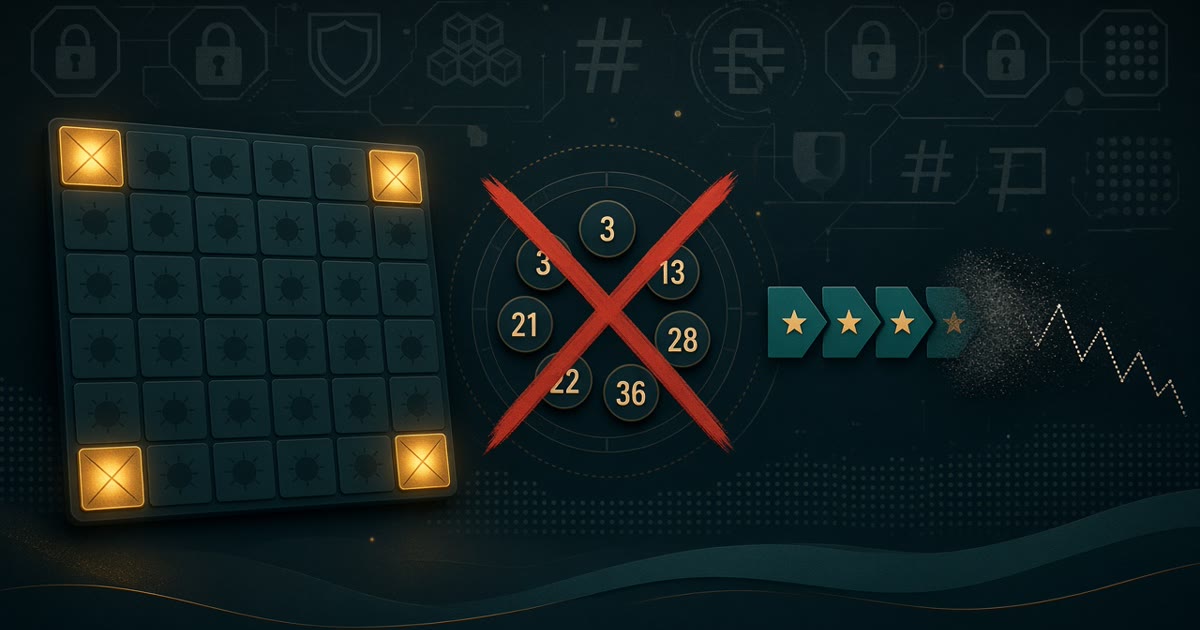
Casino pattern myths show up the moment players feel a streak: hot corners on Mines, “due” Keno numbers, Dice that “owes” a hit. On VFairGames originals, outcomes come from committed seeds — not from memory of the last tile, ball, or roll. Patterns are storytelling, not edge.
This guide names the common myths, why they fail under HMAC-SHA256 fairness, and what actually shapes sessions. Educational only — not a way to beat RTP.
The myths (and the short answer)
| Myth | Where it shows up | Reality on VFairGames |
|---|---|---|
| Hot / cold tiles | Mines corners, edges, fixed shapes | Layout is a seed-driven shuffle for that round — no spatial bias you can farm |
| Due numbers | Keno after a long miss | Each draw is independent of prior draws under the seed model |
| Owed wins | Dice, Limbo after a dry run | Win chance is set by the payout formula; past losses do not credit future hits |
| Lucky Auto Pick | Keno Auto Pick / Mines Random pick | Convenience fillers — fairness locks the draw / layout, not the human-looking pick helper |
| Animation = result | Plinko bounce, Limbo climb | UI can animate after settle; verification recomputes the HMAC result, not the physics |
Deep product loops: Mines max win, How Keno works, How provably fair Dice works. Fairness overview: What is provably fair?. Cashout habits: Mines cashout strategy.
Why “patterns” feel real
Instant games resolve in seconds. Humans are wired to find shapes in noise. A three-gem Mines streak or a Keno near-miss feels like information. It is not. Under commit–reveal:
- You see a server seed hash before play under that seed.
- Client seed + nonce feed
HMAC-SHA256. - The digest maps to the layout, draw, roll, path, or multiplier.
- After reveal, anyone can recompute and match bet history at verify.vfair.games.
Seeds and nonce: Server seed, client seed, nonce. Verify walkthrough: How to verify.
Verification proves this outcome came from these seeds. It does not prove that a corner was “due,” that RTP is generous, or that the wallet will pay.
What actually changes results
Nothing in this list invents +EV — but it is what players can control:
- Volatility dials — mine count, Keno spots/risk, Dice win chance, Limbo target, Plinko risk/rows (session shape only).
- Stake size and stop limits — bankroll management, session stop-loss.
- Staking plans — Martingale / Paroli / Fibonacci change when pain hits, not the edge (Martingale, Paroli).
If a tip needs you to believe tiles remember you, skip it.
Responsible play
Play only with money you can afford to lose. Set limits before you start. If gambling stops being fun, stop and seek help from a local responsible-gambling resource.
For operators
Myth-busting copy cuts “rigged board / due number” tickets after near-misses. Pair fairness UI with plain language: patterns are not strategy. Contact: info@vfair.games. Catalogue: games.
FAQ
Do Mines corners hit more often?
No. Mine positions come from a deterministic HMAC shuffle of the tile list for that round — not from a preferred geometry.
If a Keno number has not hit lately, is it due?
No. The next draw does not “owe” missed spots. Chase habits burn bankroll faster than they fix luck.
Does a long Dice loss streak raise the next win chance?
No. Each bet keeps the chance tied to your slider and RTP. Past losses do not bank probability.