Mines Casino Max Win — Multipliers, Mine Count Tradeoffs, and Fair Play
Learn how Mines casino max win and multipliers work on VFair — 5×5 grid math, mine-count volatility, cashout timing, and HMAC-SHA256 verification for operators.
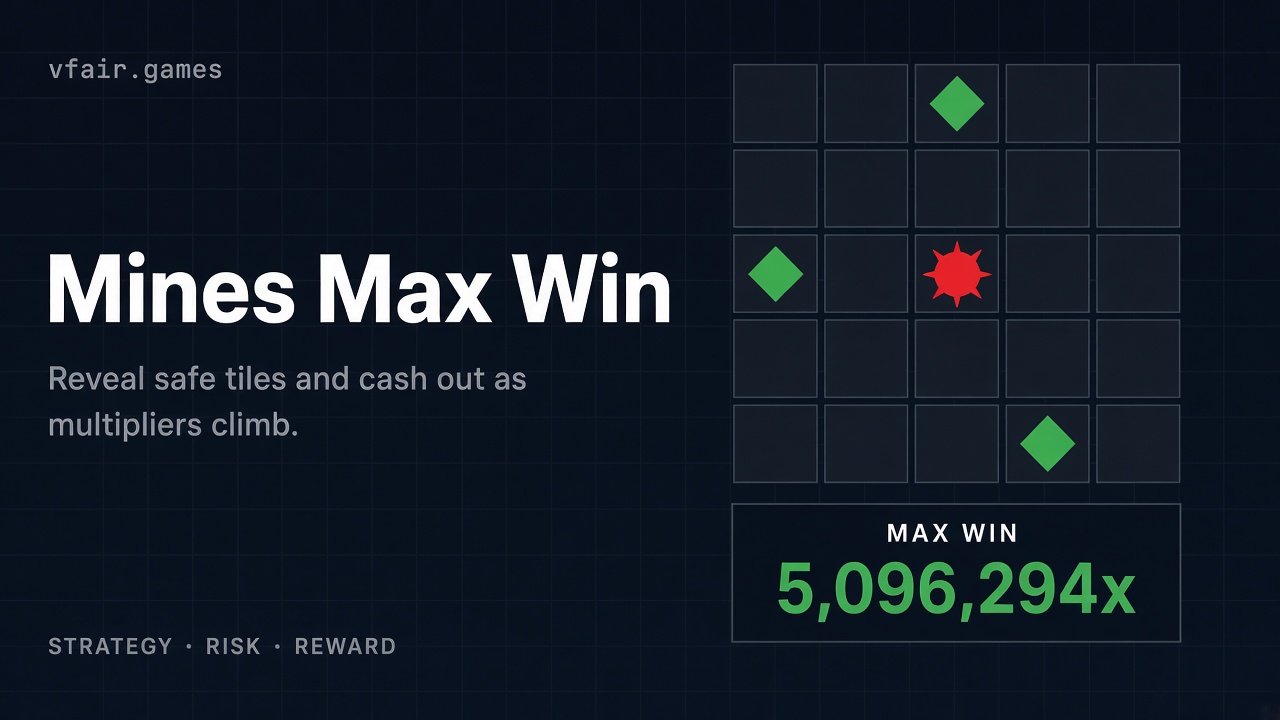
Mines casino max win is not one fixed jackpot number — it is the product of mine count, how many safe tiles you clear, configured RTP, and the partner’s per-currency profit cap. On VFair’s Mines game, a full clear with 12 or 13 mines reaches a theoretical multiplier of 5,096,294× at the default 98% RTP; real payouts still stop at the operator’s maxWin.
This post explains how VFair Mines works, where that ceiling comes from, which play styles shape session length and engagement (without “guaranteed win” myths), and how HMAC-SHA256 fairness lets anyone re-check the board.
How Mines works (quick)
VFair Mines is a push-your-luck grid game on a 5×5 board (25 tiles):
- Choose bet amount and mine count (1–24; default is 3).
- Start the round — mine positions are fixed from the fairness seeds before the first reveal.
- Reveal tiles one by one. Each safe gem raises the multiplier.
- Cash out after at least one safe reveal to lock the current payout — or keep going.
- Hit a mine and the round is lost.
Manual play supports picking tiles yourself or using Random pick. Auto mode lets players pre-select a tile set and run repeated rounds — useful for operators who care about paced sessions and clear risk ladders, not only single-click thrills.
Browse the full games catalogue for Dice, Mines, Limbo, Plinko, and Keno.
What “max win” actually means on Mines
Public Mines guides often blur three different ceilings. Separate them and the product story gets clearer:
| Ceiling | What it is | VFair reality |
|---|---|---|
| Per-step multiplier | Payout after k safe reveals at a given mine count | From fair combinatorial odds × configured RTP (default 0.98), rounded to 2 decimals |
| Theoretical max multiplier | Clearing every gem on the board | At default RTP: 5,096,294× with 12 or 13 mines (13 or 12 gems) |
| Partner max win | Hard profit cap per currency | Configurable; profit above the cap is clamped or the bet is rejected (especially in auto) |
So “mines casino max win” for an operator is usually: how high can the ladder climb in the UI, plus how much currency am I willing to pay on a single hit. Marketing a huge × number without a maxWin policy is how support queues fill up.
Sample ladder at default 98% RTP
| Mines | Gems | 1st safe | 3 safe | 5 safe | Full clear |
|---|---|---|---|---|---|
| 1 | 24 | 1.02× | 1.11× | 1.23× | 24.5× |
| 3 | 22 | 1.11× | 1.46× | 1.98× | 2,254× |
| 5 | 20 | 1.23× | 1.98× | 3.36× | 52,067.4× |
| 10 | 15 | 1.63× | 4.95× | 17.34× | 3,203,384.8× |
| 12 | 13 | 1.88× | 7.88× | 40.46× | 5,096,294× |
| 24 | 1 | 24.5× | — | — | 24.5× |
First-tile survival is simply (25 − mines) / 25 — about 96% with 1 mine, 88% with 3, 52% with 12, and 4% with 24. Multipliers climb because each successive pick is harder, not because later tiles are “luckier.”
Techniques that engage players (product view)
Independent Mines strategy write-ups converge on the same honest math: mine count does not change long-run EV when multipliers are RTP-scaled — it changes volatility, streak length, and how often someone taps cash out. Frame these as design levers, not bankroll magic.
1. Mine-count dials: grind vs spike
- Low mines (1–3) — frequent safe clicks, modest ×, longer sessions. Good for players who want many decisions per stake and for wager-style engagement.
- Mid mines (5–10) — steeper ladder after a few gems; cashout timing matters more.
- High mines (12+) — rare clears, headline multipliers (including the theoretical max at 12/13). Short rounds, sharp bust risk — the “lottery ticket” feel operators often want as a high-volatility mode.
- 24 mines — one gem on the board; a single pick at 24.5×. Extremely binary.
Default 3 mines sits in the familiar “readable risk” band most public guides recommend for new players.
2. Pre-commit cashout ladders
Math-focused guides keep repeating one practical habit: decide the stop before the first click (“3 mines, cash out after 3–5 gems”). Mid-round greedy bumps turn a locked 2× into a total loss for a thin uplift.
For product teams, that maps cleanly to UI: show next-step multiplier and remaining gems, keep cash out one tap away after the first safe reveal, and avoid burying the exit behind another reveal.
3. Ignore tile-pattern myths
Corners, edges, “hot tiles,” and fixed shapes do not beat a shuffled layout. VFair places mines with a deterministic HMAC-driven shuffle of the tile list — positions are fixed for the round, but they are not spatially biased in a way a human pattern can exploit. Teaching that up front reduces conspiracy support tickets and reinforces the fairness story.
4. Auto tile sets as risk templates
Auto mode (select tiles first, then run rounds) is how players encode a ladder without improvising every click. Operators get repeatable session shapes: same mine count + same reveal depth → predictable volatility for that player cohort.
None of this overcomes house edge. It shapes how the edge is experienced — which is what retention, responsible-gaming tooling, and VIP wager products actually care about.
Fairness: layout locked before the first reveal
Like the rest of the VFair catalogue, Mines uses HMAC-SHA256 commit–reveal:
- Players see a server seed hash before play under that seed.
- A client seed and per-bet nonce feed the HMAC message.
- The digest drives a Fisher–Yates-style shuffle; the first mineCount indices become the mine layout.
- After reveal, anyone can recompute the layout and match the board.
That is why mid-round “the mines moved” is a non-issue if verification holds. Deep dive: What is provably fair gaming?. Independent check: verify.vfair.games.
Provably fair confirms the formula and seeds — not that RTP is generous or that wallet settlement will pay. Partner maxWin and wallet rules still sit outside the hash.
Why operators ship Mines this way
Compared with fixed-paytable slots, Mines gives partners:
- A visible risk control (mine count) players understand in one glance.
- A cashout decision loop that drives engagement without needing live dealers.
- Configurable RTP and currency maxWin for market-specific risk.
- The same fairness stack as Dice, Limbo, Plinko, and Keno — one verification story across originals.
If you are evaluating integration, start from the Mines product page or email info@vfair.games.
FAQ
What is the Mines casino max win on VFair?
At default 98% RTP, clearing every gem with 12 or 13 mines yields a theoretical multiplier of 5,096,294×. Actual cash paid is still limited by the partner currency’s maxWin profit cap.
Does more mines raise RTP?
No. With RTP-scaled multipliers, expected value stays aligned to the configured RTP; higher mine counts raise volatility and peak multipliers, not the long-run edge.
When can players cash out?
After at least one safe reveal, anytime during the active round. Hitting a mine before cash out loses the stake. Leaving a round open does not reshuffle the board — the layout was already fixed.
Are tile patterns a real Mines strategy?
No. Safe and mine tiles are assigned by the fairness shuffle. Patterns can feel meaningful; they do not change the probabilities.
How do you verify a Mines round?
Confirm the revealed server seed matches the pre-play hash, recompute HMAC-SHA256 with client seed and nonce, regenerate the mine layout, and compare it to the result — in-game or via verify.vfair.games.